

Kong vs Nina Ottosson Puzzle Toys: 2026 Comparison
Last Updated: October 23, 2026
Quick Summary
Kong and Nina Ottosson puzzle toys solve the same problem in opposite ways: Kong builds rubber toys that dispense food through motion, while Nina Ottosson builds plastic puzzle boards that ask dogs to slide, lift, and unlock compartments. Choose rubber for chewers and plastic boards for thinkers, and start one difficulty level below where you think your dog sits.
- Kong rubber toys flex under jaw pressure instead of cracking, making them the pick for chewing, teething, and treat dispensing.
- Nina Ottosson labels its boards across four difficulty levels, with the MultiPuzzle sitting at the expert tier.
- Introduce a puzzle toy with short five to ten minute sessions and increase difficulty only after two or three confident solves.
- Replace rubber dispensers when the cavity wall thins or splits, and retire puzzle boards at the first broken or missing piece.
- No puzzle is indestructible, so treat every board as a supervised activity rather than a leave-behind toy.
Table of Contents
- Kong vs Nina Ottosson Puzzle Toys: A Side-by-Side Comparison
- KONG Treat-Dispensing Toys: Rubber Durability and Chewing
- Nina Ottosson Dog Puzzles: Board Games and Difficulty Tiers
- Dog Puzzle Toy Difficulty Levels Explained
- How to Introduce a Dog to Puzzle Toys
- Durability, Cleaning, and Replacement: What Owners Miss
- Which Puzzle Toy Fits Your Dog? A Decision Guide
- Frequently Asked Questions
Kong vs Nina Ottosson Puzzle Toys: A Side-by-Side Comparison
Kong and Nina Ottosson puzzle toys solve the same problem in opposite ways: Kong builds rubber toys that bounce and dispense food through motion, while Nina Ottosson builds plastic puzzle boards that ask dogs to slide, lift, and unlock compartments. This comparison from Chelsy's Toys breaks down both families by difficulty, durability, and best use, so you can match a puzzle toys purchase to your dog's chewing style and experience level instead of guessing from packaging.
The distinction matters more than most roundups admit. A rubber treat-dispenser rewards persistence and movement. A puzzle board rewards careful problem-solving. Pick the wrong type and you get a bored dog or a destroyed toy.
| Feature | KONG Classic & Treat Toys | Nina Ottosson Puzzles | Best For |
|---|---|---|---|
| Material | Thick natural rubber | Plastic boards and composite pieces | Rubber for chewers, plastic for thinkers |
| How it works | Food falls out as the toy rolls | Sliding pieces, lifting lids, locking drawers | Motion vs. manipulation |
| Difficulty | Single level, adjustable by stuffing | Four tiers, beginner to expert | Ottosson for progression |
| Supervision | Supervised or short solo play | Supervised play recommended | Both need a watchful eye |
| Cleaning | Rinse and air-dry | Hand-wash moving parts | Kong is simpler |
| Best use | Chewing, teething, treat dispensing | Mental stimulation, problem-solving | Depends on the dog |
Comparison Table: Price, Difficulty, and Best Use
Kong's core appeal is a low entry price and a single, forgiving difficulty curve. Nina Ottosson's appeal is a structured learning path, with products labeled by level so owners can advance a dog from beginner to expert. If your dog gives up easily, start with a rubber dispenser. If your dog solves everything in seconds, a level 3 or 4 board is the better spend.
KONG Treat-Dispensing Toys: Rubber Durability and Chewing
KONG's rubber construction is the reason the brand dominates treat-dispensing toys. The material flexes under jaw pressure instead of cracking, and stuffing the cavity with food turns chewing into a job. As noted in The Spruce Pets' 2026 dog puzzle toy roundup, the KONG Classic is built for chewing, teething, and treat use, which is why it doubles as a puppy pacifier and a slow feeder.
That durability has limits. A determined power chewer can still work through rubber over time, especially if the toy is left down all day. Rotate it out of rotation between sessions and inspect for splits.
If you want a treat dispenser built from a different material entirely, our Adjustable Slow-Feed Treat Dispenser for Puppies and Seniors | Durable Enrichment Puzzle Toy for Mental Exercise and Calm Play includes adjustable designs that pace food release differently than a rubber cavity.

Nina Ottosson Dog Puzzles: Board Games and Difficulty Tiers
Nina Ottosson puzzles are board games for dogs: flat or boxed plastic units with sliding pieces, lifting lids, and locking drawers that hide food rewards. The design leans on a dog's nose and paws rather than its jaws, which makes these toys a better fit for mental stimulation than for heavy chewing. Nina Ottosson's own puzzle game catalog organizes products by difficulty, and the brand's MultiPuzzle sits at the expert level for dogs that have already mastered the lower tiers.
The trade-off is fragility under teeth. Plastic puzzle boards are not chew toys, and a dog that mouths the pieces instead of nosing them will shorten the toy's life.
Dog Puzzle Toy Difficulty Levels Explained
Dog puzzle toy difficulty levels describe how many steps a dog must complete to reach a reward, and most puzzle brands run a four-tier scale from beginner to expert. Nina Ottosson labels products across four levels, with level one aimed at puppies and first-timers and the top tier reserved for dogs that have already solved the easier boards. Kong takes a simpler route: one toy, with difficulty tuned by how tightly you pack the food.
The practical rule is to start one level below where you think your dog sits. A dog that fails repeatedly loses interest fast, and a puzzle that gets solved in seconds stops being enrichment. For a broader list of options across both styles, our guide to the best puzzle toys for bored dogs compares difficulty tiers side by side.
How to Introduce a Dog to Puzzle Toys
Introduce a puzzle toy by making the first session almost too easy. Show your dog the food, place it where it is visible, and let the toy do the teaching. Most dogs need trial and error, not instruction.
- Start with food rewards your dog can smell from a distance.
- Use a beginner-level puzzle or a loosely stuffed rubber toy.
- Let your dog see you load the treat the first few times.
- Keep sessions short, five to ten minutes, and end on a win.
- Increase difficulty only after two or three confident solves.
Persistence matters more than speed. A dog that paws, noses, and circles the toy is learning. A dog that walks away needs an easier setup. If you are new to enrichment overall, our complete guide on why dogs need brain games explains how problem-solving sessions fit into a daily routine.
Adjustable Slow-Feed Treat Dispenser for Puppies and Seniors | Durable →
Durability, Cleaning, and Replacement: What Owners Miss
Durability is where the two families diverge most, and it is the part most reviews skip. Rubber and plastic fail in different ways, need different cleaning routines, and should be replaced on different schedules. Getting this right is the difference between a toy that lasts a year and one that lasts a month.
How each material fails. Rubber dispensers fail from the inside out. Persistent chewing thins the walls around the cavity, and the first sign is usually a split at the rim or a soft spot near the opening. Plastic puzzle boards fail at the moving parts: sliding pieces crack at the edges, hinges loosen, and locking tabs snap. A board can look intact and still be unsafe if a piece has become a choking hazard.
Cleaning routines. Rubber toys rinse in warm water and air-dry quickly, but the cavity traps residue if you only rinse the outside. A bottle brush or a quick soak in warm, soapy water handles the inside. Puzzle boards are the harder job: crumbs and saliva collect in compartments, under sliding pieces, and around hinges. Most manufacturers advise hand-washing moving parts rather than putting the whole board in the dishwasher, because heat and tumbling can warp plastic and loosen mechanisms.
Wear indicators to check after every session.
- Rubber: splits at the rim, soft or tacky spots, pieces missing from the cavity wall.
- Plastic: cracked sliding pieces, loose hinges, missing tabs, sharp edges where a piece has broken.
- Both: lingering odor that survives washing, or residue you cannot reach.
Replacement framework. Replace rubber dispensers when the cavity wall thins or splits, not when the toy looks dirty. Replace puzzle boards at the first broken or missing piece, because a loose part is a swallowing risk. A reasonable rule of thumb: inspect after every heavy session, and retire any toy with a defect rather than leaving it down 'for a bit.'
Supervision is part of durability. No puzzle toy is indestructible, and the fastest way to lose a board is to leave it down as a chew toy. Treat every board as a supervised activity and every rubber dispenser as a supervised or short-solo toy, and rotate both out of the rotation between sessions. Owners of strong chewers should read our picks for durable enrichment toys for power chewers before buying another board.
Which Puzzle Toy Fits Your Dog? A Decision Guide
Match the toy to the dog, not to the trend. Use this framework:
- Power chewer: rubber treat dispenser or a fleece tug-and-dispense toy. Skip plastic boards.
- Puppy or senior: soft, adjustable dispensers with large openings and gentle materials.
- Fast solver: a level 3 or 4 puzzle board with locking drawers.
- Anxious or easily frustrated dog: beginner puzzles and short, easy wins.
- Full-time alone dog: durable chew-and-dispense toys for solo time, boards for supervised play.
Our own approach at Chelsy's Toys leans on fleece-based enrichment that combines sniffing, tugging, and treat release in one toy, which suits dogs that lose interest in single-purpose puzzles. You can also get a custom enrichment plan to match toys to your dog.
Frequently Asked Questions
How do KONG toys compare with Nina Ottosson puzzle toys?
They solve different problems. KONG treat-dispensing toys are rubber, chew-tolerant, and built for stuffing and freezing, so they suit power chewers and long-lasting solo chewing. Nina Ottosson dog puzzles are plastic boards with sliding pieces, lifting lids, and locking drawers that reward problem-solving. Most owners pair them: a KONG for chewing and a puzzle board for mental stimulation. Neither is indestructible, and both makers advise supervised play.
Are Nina Ottosson puzzles suitable for beginners?
Yes. Nina Ottosson rates its puzzles on four difficulty levels, and level one is aimed at puppies and first-time dogs. Start there even if your dog is bright. A beginner puzzle teaches the mechanics, like nosing a lid or pawing a slider, so the dog learns the game before the challenge increases. Move up only when your dog solves the current level quickly and without frustration.
How do I choose the right difficulty level for a dog puzzle?
Match the level to the dog, not the breed. Start at beginner, watch the first three sessions, and note whether the dog solves it in under a minute or gives up. Fast, confident solvers can move up a level. Dogs that walk away or bark need an easier setup or higher-value food rewards. A puzzle should take a few minutes of trial and error, not seconds.
Should dogs be supervised while using puzzle toys?
Yes, at least until you know how your dog interacts with the toy. Outward Hound's guide states no puzzle is indestructible and advises against leaving pets unsupervised with puzzle toys. Supervised play lets you spot loosened parts, chewed edges, or swallowed pieces early. Once your dog reliably works the puzzle without chewing it, short solo sessions are reasonable, but inspect the toy afterward.
What toy should I get for a dog that destroys everything?
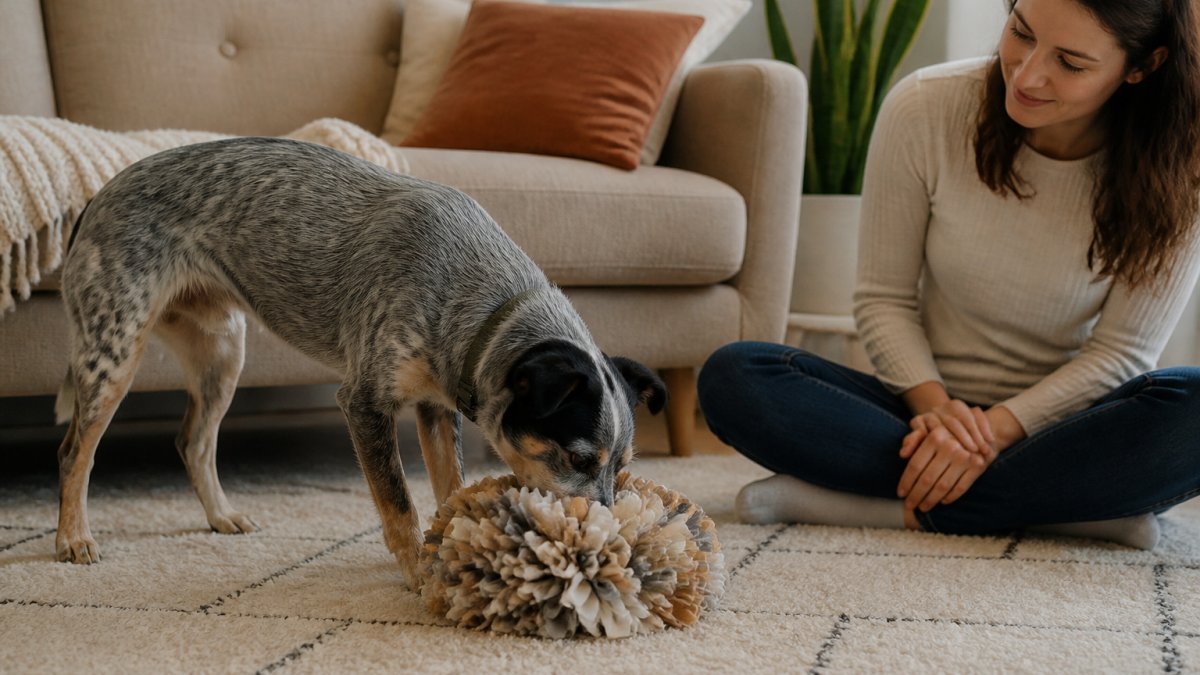
For a dog that shreds plush toys in minutes, choose a rubber treat-dispensing toy for chewing and a sturdy puzzle board for thinking, and rotate them. Fleece enrichment toys like a snuffle ball work well for sniffing and foraging but are designed for supervised interactive play, not leave-down chewing. Match the material to the behavior: chewing needs rubber, problem-solving needs a puzzle, and sniffing needs fabric.
Kong and Nina Ottosson both make good puzzle toys, but neither is built to survive a determined power chewer left alone all day. If that describes your dog, fleece-based enrichment from Chelsy's Toys offers a different outlet: handmade, patented designs like our Enrichment Tube and Snuffle Ball that combine foraging, tugging, and treat release, backed by our 30-day happy-dog guarantee. Get started with Chelsy's Toys and give your dog a job that holds up to daily use.
