

7 Things a Dog Enrichment Guarantee Actually Covers
Last Updated: November 6, 2026
Quick Summary
A dog enrichment guarantee is a seller's time-limited promise that a toy will hold up under normal enrichment use, typically 14 to 90 days, or you get a refund or replacement. It covers defects in stitching or materials and failure during intended use, but not normal chewing wear or behavior outcomes.
- An enrichment guarantee is a product guarantee, not a lifetime warranty or an outcome claim.
- Our 30-day happy-dog guarantee covers the build, not a behavior timeline.
- Read the guarantee before the product description, checking the time window and normal use definition.
- No fabric toy is indestructible, so supervise play and put soft toys away between sessions.
- If nothing changes after two weeks of daily enrichment, rotate activity categories rather than trying harder.
Table of Contents
- What Is Dog Enrichment and Why It Needs a Guarantee
- What a Dog Enrichment Guarantee Actually Promises
- How to Read a Guarantee's Terms Before You Buy
- Dog Enrichment Toys That Hold Up to Real Chewing
- Dog Enrichment Ideas DIY for Days You're Short on Time
- Dog Enrichment Ideas While at Work So Your Dog Stays Busy
- How to Tell If Enrichment Is Actually Working
- Choosing Enrichment Toys Backed by a Real Guarantee
- Frequently Asked Questions
What Is Dog Enrichment and Why It Needs a Guarantee
Dog enrichment is the practice of giving your dog outlets that satisfy natural instincts like sniffing, foraging, chewing, and problem-solving.
That distinction matters because enrichment toys take real abuse. A toy built for sniffing and chewing gets soaked, frozen, tugged, and buried in treats. If it falls apart in a week, the enrichment stops and you're out the money.
At Chelsy's Toys, we've sold handmade enrichment toys since 2006, and the guarantee question comes up often. Owners want to know the toy will survive their dog, not just arrive in nice packaging.
Enrichment itself is not a luxury. It covers physical stimulation, mental stimulation, and emotional wellbeing, and it gives dogs a job to do instead of a couch to destroy.
What a Dog Enrichment Guarantee Actually Promises
An enrichment guarantee is a time-limited refund or replacement promise tied to how a toy performs in real use.
Service guarantee. A trainer, daycare, or enrichment service promises a certain number of sessions, a certain activity menu, or a response if your dog is not engaged.
Outcome claim. A seller implies that using the product will produce a behavioral result, less destruction, calmer evenings, faster settling.
Here is what a typical product guarantee covers and what it does not:
| What's Covered | What's Usually Excluded |
|---|---|
| Defects in stitching or materials | Normal wear from chewing |
| Failure during intended use | Damage from unsupervised destruction |
| Missing or wrong items | Damage from heat, bleach, or wrong washing |
| Refund or replacement within the window | Vet bills or behavior outcomes |
Our 30-day happy-dog guarantee sits in that first column. It is a product guarantee, not an outcome claim, it covers the build, not a behavior timeline.
Watch out: a guarantee that promises behavior results without defining how they are measured is not a guarantee you can enforce.
Guarantee of Activities vs. Guarantee of Outcomes
The distinction that matters most for enrichment is between a guarantee that activities will be provided and a guarantee that a dog's behavior or wellbeing will change.
A guarantee of activities says: you will receive the toy, the plan, or the sessions you paid for, and they will be as described. That is enforceable and reasonable. A guarantee of outcomes says: your dog will stop chewing furniture, will settle faster, or will be calmer within a set time. That is not enforceable in any meaningful way because the variables, your dog's age, health, breed drive, home routine, and consistency, are outside the seller's control.
A useful middle ground is a guarantee of support: the seller promises to help you troubleshoot or replace a toy that fails. It is the kind of guarantee worth asking about before you buy.
How to Read a Guarantee's Terms Before You Buy
Read the guarantee before you read the product description. The terms tell you more about quality than any marketing photo.
Most guarantees hide their limits in three places: the time window, the definition of "normal use," and the proof required. A guarantee that asks for photos and a receipt is normal. One that excludes "chewing damage" on a chew toy is a red flag.
Questions to Ask About Any Guarantee
Run through this checklist before you check out:
- How many days does the window last, and does it start at delivery or purchase?
- Does it cover replacement, refund, or store credit?
- What counts as "normal use" for this specific toy?
- Do I need the original packaging or receipt?
- Who pays shipping on a replacement?
- Is the guarantee void if my dog is a known power chewer?
- Can I see the full terms in writing before I buy?
If a seller can't answer these in plain language, the guarantee is decoration.
Dog Enrichment Toys That Hold Up to Real Chewing
Durability is the whole point of a guarantee, so look at construction before you look at claims.
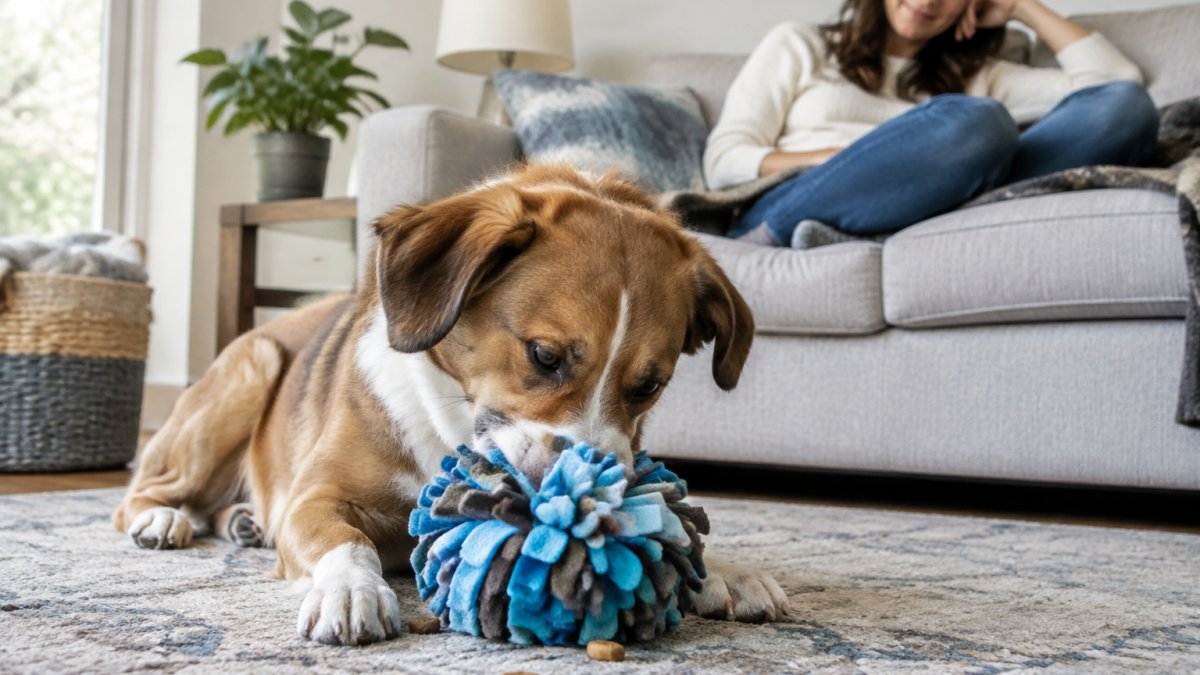
Fleece gets a bad reputation it doesn't deserve. Cheap fleece shreds. Tightly knotted fleece, made with layered construction, holds together through tugging and chewing because the force spreads across many knots instead of one seam.
Our Patented Tug Toy uses Fletch Technology™, a stretch-and-lock build with over 150 interlocking knots. It is soft on teeth and gums.
Watch out: no fabric toy is indestructible. If your dog shreds and swallows fabric, supervise play and put the toy away between sessions. That is true of every soft toy on the market, including ours.
If you want concrete picks for heavy chewers, our guide to durable enrichment toys for power chewers breaks down which builds survive which chew styles.
3-in-1 Bundle Enrichment Tube for Dogs - Tug Toy, Treat Dispenser & Snuffle Ball →
Dog Enrichment Ideas DIY for Days You're Short on Time
DIY enrichment works best when it takes under five minutes to set up. The goal is to make your dog work for food, not to build a craft project.
Try these when time is tight:
- Snuffle scatter. Toss kibble across a rug or a patch of grass and let your dog hunt for it.
- Muffin tin game. Drop treats in a muffin tin and cover the cups with tennis balls.
- Frozen broth cube. Freeze low-sodium broth in a silicone mold for a cooling licking activity.
- Towel roll. Roll treats inside a damp towel, freeze it, and let your dog unroll it.
- Cardboard forage box. Hide kibble in a shallow box with crumpled paper.
These cover scent work, foraging, and problem-solving with things you already own.
For a high-energy dog who needs more than five minutes of setup, our breakdown of how to mentally stimulate a high-energy dog goes deeper into matching activities to drive level.
Dog Enrichment Ideas While at Work So Your Dog Stays Busy
A workday alone is long. The fix is not one toy, it is a rotation that spreads engagement across the hours you're gone.
Build the day in layers:
- Morning: a sniff-heavy breakfast scatter before you leave.
- Mid-morning: a frozen stuffed toy that takes time to thaw and work through.
- Afternoon: a treat dispenser with adjustable difficulty so the challenge stays interesting.
- Evening: interactive tug or training time with you.
The Adjustable Slow-Feed Treat Dispenser has three hole sizes and a removable inner tube divider, so you can start easy and make it harder as your dog gets better at it.
A common mistake is leaving the hardest puzzle out all day. Most dogs give up or get frustrated. Rotate difficulty instead.
For a full step-by-step plan, see how to keep your dog occupied while working.
How to Tell If Enrichment Is Actually Working
Enrichment may be working when your dog settles faster after a session and destructive behavior drops over time. The signs are behavioral, not dramatic, and they show up best when you measure against a baseline instead of relying on memory.
Set a Baseline First
Before you change anything, spend three to five days noting what a normal day looks like. Record four things: how long it takes your dog to settle after a meal or walk, how many destructive incidents happen (chewing furniture, shredding cushions, counter-surfing), how much time is spent pacing or whining, and how your dog recovers when you leave the room. A simple notes app or paper log is enough. The baseline is what makes the next two weeks readable.
Observable Indicators to Track
Look for these changes against your baseline:
- Engagement. Your dog works a puzzle or snuffle toy for longer before losing interest, or returns to it after a break.
- Settling time. The gap between the end of an activity and a calm lie-down gets shorter.
- Recovery after activity. After a vigorous tug or sniff session, your dog returns to a relaxed state faster instead of staying amped up.
- Destructive behavior. Furniture chewing, cushion shredding, and pacing drop over two to three weeks of consistent daily enrichment.
- Stress-related behavior. Less whining, less door-scratching, and fewer stress signals when you prepare to leave.
- Focus during training. Your dog checks in more readily and holds attention for slightly longer stretches.
Keep the log for two weeks. Note the activity, the time, and how your dog acted afterward.
When the Indicators Are Flat
If nothing changes after two weeks of consistent daily enrichment, the issue is usually activity type, not effort. A dog who needs chewing may not be satisfied by sniffing alone, and a dog who needs scent work may ignore a puzzle toy. Rotate categories, food-based, puzzle, scent, chew, physical play, social, and see which one moves the indicators. If a specific category consistently produces engagement and settling, build the routine around it.
Watch out: if your dog shows signs of pain, sudden behavior change, or distress during enrichment, stop and consult a veterinarian or qualified behavior professional before continuing. Enrichment is not a substitute for medical or behavioral care.
To confirm you're meeting natural instincts, our guide to satisfying dog foraging instincts covers proven methods for building a routine that actually lands.
Choosing Enrichment Toys Backed by a Real Guarantee
A guarantee is only as good as the toy behind it. Start with construction, then check the terms, then check the seller's track record.
Here is how we would choose:
- Confirm the toy matches your dog's chew style and size.
- Read the guarantee window and exclusions in full.
- Check whether the seller answers questions before you buy.
- Start with one toy, not a bundle, and test it under supervision.
- Add variety once you know what your dog engages with.
Our enrichment dog toys collection includes the Enrichment Tube, Snuffle Ball, and Patented Tug Toy, all handmade from quality fleece and covered by our 30-day happy-dog guarantee.
A guarantee doesn't replace good supervision. It backs a product that was built to be used.
Frequently Asked Questions
What does a dog toy guarantee usually cover?
Most toy guarantees cover manufacturing defects, stitching failures, or premature breakdown under normal use within a set window, often 30 days. An enrichment guarantee goes further by tying the promise to engagement: the toy should keep your dog occupied and interested, not just stay in one piece. Read the fine print to see whether chewing damage counts as normal wear or a defect, and whether you need the original packaging or receipt to claim.
Can enrichment toys help reduce destructive chewing?
They can give your dog a better outlet for the same drive. Puzzle toys, snuffle balls, and treat dispensers can give chewing and foraging instincts a productive task. Pair them with supervision and rotate toys so your dog does not get bored and go back to the couch legs.
Are enrichment toys safe to leave with a dog unsupervised?
It depends on the toy and the dog. Interactive toys like tug ropes and fleece tugs are built for supervised play and should be put away between sessions. Check each listing's safety notes before leaving any toy with your dog unsupervised. Power chewers should always be monitored until you know how they handle a new toy, and any toy with loose strands or holes should be pulled from rotation immediately.
How do I know if an enrichment toy is right for my dog?
Match the toy to your dog's size, chew style, and energy level. High-energy power chewers need reinforced stitching and denser materials, while puppies and seniors do better with softer fleece and adjustable difficulty. Start with one toy, watch how your dog interacts with it for a week, and note whether they stay engaged or lose interest in minutes. A good guarantee should let you test that fit without risking the full purchase price.
Your dog's destructive chewing won't fix itself, and another flimsy toy from the big-box shelf won't either. Chelsy's Toys builds handmade fleece enrichment toys with patented designs, including Fletch Technology™ construction and adjustable treat dispensers, all covered by our 30-day happy-dog guarantee. Get started with Chelsy's Toys and give your dog a job that holds up.
