

Why Do Dogs Destroy Soft Toys? Vet-Backed Answers
Last Updated: October 29, 2026
Quick Summary
Dogs destroy soft toys because shredding satisfies hardwired instincts: the chase-and-catch sequence of prey drive, the tension release of chewing, and the mental outlet that boredom demands. The squeaker mimics a small animal's cry, and ripping the toy open completes the predatory sequence. A tired, mentally worked dog shreds far less.
- Soft toys trigger every step of prey drive: stalk, chase, grab, shake, and dissect.
- Dogs remove stuffing because the toy's core, especially the squeaker, is the prize inside.
- Loose stuffing, fabric scraps, and plastic squeakers can cause choking or an intestinal blockage.
- Destruction that starts within minutes of you leaving points to separation-related distress, not play.
- Supervise every soft toy session and redirect the moment teeth find a seam.
Table of Contents
- Why Do Dogs Destroy Soft Toys? The Instincts Behind the Shredding
- Why Do Dogs Like to Remove Stuffing From Toys?
- The Real Risks: Swallowed Stuffing, Squeakers, and Blockages
- Normal Play or Anxiety? How to Tell the Difference
- How to Stop a Dog From Destroying Toys: A Step-by-Step Plan
- Safe Toys for Aggressive Chewers: Match the Toy to the Dog
- Dog Enrichment Toys That Give Destruction a Better Outlet
- Shop Enrichment Toys Built for Power Chewers
- Frequently Asked Questions
Why Do Dogs Destroy Soft Toys? The Instincts Behind the Shredding
Dogs destroy soft toys because shredding satisfies hardwired instincts: the chase-and-catch sequence of prey drive, the tension release of chewing, and the mental outlet that boredom demands. At Chelsy's Toys, we hear the same question every week: "Why do dogs destroy soft toys when they have a whole basket of them?" The answer is rarely about being bad. It is about being a dog.
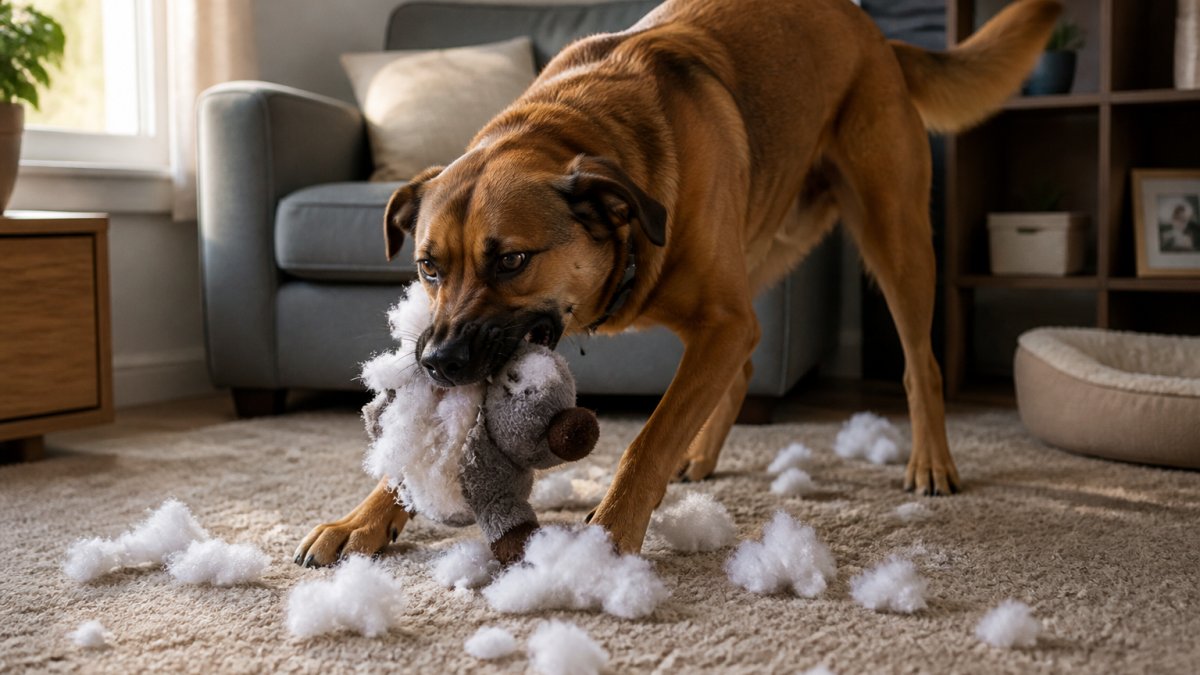
A stuffed toy looks like a baby blanket to us. To your dog, it can look like prey. Many squeaking toys make a sound when bitten, which can reward the behavior.
Prey Drive and the Hunting Instinct
Prey drive is the instinctive sequence of stalk, chase, grab, shake, and dissect. Soft toys trigger every step. The squeaker mimics a small animal's cry. The plush surface gives way under teeth. Shaking "kills" the toy, and ripping it open completes the sequence.
Trainers often describe this as predatory behavior in its most harmless form, and it is generally not a sign of aggression.
Chewing Drive, Boredom, and Excess Energy
Chewing is both a stress reliever and an energy burner. A dog with an empty afternoon and no outlet will find one. Soft toys are the easiest target in the house.
Watch for these signs that boredom is the driver:
- Destruction happens mostly when you are away or busy
- Your dog targets whatever is softest and easiest to tear
- Energy spikes after long stretches without exercise
- The behavior stops when something better is offered
A tired, mentally worked dog shreds far less. That is the lever most owners miss.
Why Do Dogs Like to Remove Stuffing From Toys?
Dogs remove stuffing because the toy's core is the reward. The outer fabric is packaging. The stuffing, and especially the squeaker, is the prize inside.
Think about the sequence from your dog's side. The squeaker makes noise. Your dog bites harder to hear it again. The seam splits. Now there is a new game: pull everything out.
Veterinary behavior guidance commonly frames this as dissection play, a normal part of predatory behavior.
Squeakers make it worse. A squeaker is a small, high-pitched sound that closely matches prey vocalizations. Many dogs will work a toy for an hour just to silence it.
The Real Risks: Swallowed Stuffing, Squeakers, and Blockages
The real danger in toy destruction is ingestion, and the danger scales with the size of the piece relative to the dog. Loose stuffing, fabric scraps, and plastic squeakers can cause choking or an intestinal blockage, which often means surgery.
Here is the mechanism most owners never hear explained. Small pieces of fleece, stuffing, or squeakers can lodge in the throat or pass into the digestive tract, where they may cause a blockage that needs veterinary care.
Blockage signs, timeline matters. A blockage often does not show up the moment the piece is swallowed. A common pattern is vomiting that starts within hours to a day, comes in waves, and does not stop; drooling; refusal to eat; a belly that feels tight or painful to touch; and straining to defecate with little or nothing coming out. Any of these after a known or suspected ingestion is a call-your-vet-now situation, not a wait-and-see.
Size is the variable you can control. If a toy or a piece of one can fit entirely inside your dog's mouth, it may be small enough to swallow, so supervision matters: remove loose pieces before they become a meal.
A practical supervision protocol:
- Pick up loose stuffing the moment it appears, before your dog can gulp it.
- Remove and discard broken squeakers immediately, do not leave them on the floor "for later."
- Put destroyed toys out of reach, not back in the basket where they get re-shredded.
- Choose toys sized appropriately for your dog, and check seams after every session.
- Know your dog's chewing style before you buy (see the selection guide below).
If you suspect ingestion, do not induce vomiting unless a veterinarian tells you to. The ASPCA Animal Poison Control Center is a resource for toxic exposures; for a suspected blockage or choking, your veterinarian is the right first call.
Normal Play or Anxiety? How to Tell the Difference
Destruction during play is normal. Destruction tied to your absence, pacing, drooling, or escape attempts points to separation-related distress.
Here is the practical split we use with customers:
The Ultimate Puppy Enrichment & Teething Pack | Gentle, engaging, and designed →
| Signal | Normal Play | Possible Anxiety |
|---|---|---|
| Timing | Happens while you are home | Starts within minutes of you leaving |
| Target | Toys, with some furniture interest | Doors, crates, window frames |
| Body language | Loose, bouncy, play bows | Pacing, panting, drooling |
| Recovery | Calms quickly after play | Stays agitated, destructive for hours |
| Appetite | Normal | Often drops while alone |
If the right column looks familiar, the toy is not the fix. Talk to your vet about a behavior plan. For dogs whose distress shows up as shredding, our guide to best dog toys for separation anxiety covers calming options.
How to Stop a Dog From Destroying Toys: A Step-by-Step Plan
You can stop the shredding by giving the instinct a legal target. Follow these steps in order.
- Sort the toy basket. Remove anything already torn, plus any toy with an exposed squeaker.
- Supervise every soft toy session. Soft toys become interactive toys you play together, not leave-behind chews.
- Redirect the moment teeth find a seam. Swap in a tug toy and play for two minutes.
- Add daily mental work. Sniffing, searching, and puzzle feeding tire a dog faster than a walk.
- Rotate toys. Keep three or four out and store the rest. Novelty does real work.
- Match toys to your dog's chewing style. More on that below.
- Log what happens. Note time, trigger, and target for two weeks. Patterns appear fast.
For the full behavior plan, read our deeper guide on how to stop dog destructive chewing.
Safe Toys for Aggressive Chewers: Match the Toy to the Dog
Safe toys for aggressive chewers share three traits: they are built for tugging and carrying, they have no loose parts to swallow, and they are sized to the dog. Match by size and play style, not by breed label, a 60-pound power chewer and a 12-pound terrier need different toys, and so do a shredder and a chaser.
Use this decision guide instead of guessing:
Step 1, Size the toy to the mouth, not the breed. The toy should be large enough that your dog cannot fit it entirely behind the front teeth. If it disappears into the mouth, it is a swallowing risk. When in doubt, size up.
Step 2, Identify the play style. Watch one session and pick the pattern that fits:
- Power chewer: bears down and gnaws in place. Needs thick, tightly constructed material with no exposed squeakers.
- Shredder: works seams and pulls until the toy opens. Needs a toy that rewards searching instead of ripping, hidden treat pockets, snuffle designs, tight knots.
- Chaser and tugger: wants the interaction, not the destruction. Needs a toy built for two-ended tugging and carrying.
- Dissector: methodically removes stuffing and squeakers. Needs supervised interactive play only, plus a legal outlet for the dissection urge.
Step 3, Match the material to the stage of life.
- Puppies and teething dogs: soft fleece that is gentle on gums and freezer-safe for cooling sore mouths.
- Adult power chewers: thick, hand-tied fleece with tight knots and no loose parts.
- Senior dogs: lightweight toys that are easy to carry and sniff, with lower resistance.
Step 4, Accept the trade-off. No soft toy is both satisfying to shred and safe to leave alone with a determined destroyer. The honest trade-off is this: the more a toy rewards tearing, the more supervision it requires. Choose the toy for the session you are actually going to run, interactive play with you, or solo enrichment, and do not expect one toy to do both.
Our roundup of durable enrichment toys for power chewers breaks down specific picks by size and chewing style.
Dog Enrichment Toys That Give Destruction a Better Outlet
Enrichment toys redirect the shredding instinct into sniffing, solving, and tugging. That is the whole strategy: give the drive a job.
This is where we built our business. Chelsy's Toys is a woman-owned business established in 2006, and our handmade fleece designs are made to be tugged, frozen, and washed.
Two examples from our line:
- The 3-in-1 Bundle Enrichment Tube ($34.99) combines a patented tug toy, a treat-dispensing tube, and a snuffle ball in one design.
- The Snuffle Ball ($12.99) lets you hide treats in the fleece so your dog can sniff and search.
Megan L. in Boise puts it simply: "The snuffle ball gives my dog a job to do. Ten minutes of sniffing leaves him happier and more relaxed than a long walk."


Shop Enrichment Toys Built for Power Chewers
The instinct to shred is not going away. Your job is to point it somewhere safe.
Chelsy's Toys offers patented enrichment designs, handmade fleece construction, and a 30-day happy-dog guarantee. Our toys are designed for tugging, freezing, and washing.
Get started with Chelsy's Toys and turn your dog's destruction drive into focused, confident play.
Frequently Asked Questions
Is it safe for dogs to rip apart soft toys?
Only with supervision. Ripping and shredding satisfies prey drive, but swallowed stuffing, fabric scraps, and squeakers can cause choking or intestinal blockage, which may require surgery. Inspect toys before and after every session, remove loose pieces immediately, and take away any toy your dog has opened up. If your dog tends to swallow rather than spit out pieces, consider switching to toys that are sized appropriately for your dog and supervise closely.
How can I stop my dog from destroying stuffed toys?
Redirect rather than punish. Rotate toys so novelty stays high, increase daily physical exercise and mental stimulation, and offer durable dog enrichment toys like snuffle balls and treat dispensers that keep your dog working for rewards. Teach a solid drop-it cue, supervise plush play, and put stuffed toys away between sessions. If destruction spikes when you leave, address the separation-related distress with a vet or trainer instead of simply removing toys.
What should I do if my dog swallows toy stuffing?
Call your veterinarian or an emergency clinic right away, even if your dog seems fine. Stuffing does not break down and can bunch up in the intestines, causing a blockage. Watch for vomiting, loss of appetite, lethargy, straining to defecate, or a painful belly, and never induce vomiting unless a vet tells you to. Bring the toy's packaging so the vet knows the material and size involved.
Can boredom or separation anxiety make a dog destroy toys?
Yes. Boredom and pent-up energy are among the most common reasons dogs shred soft toys, and destruction that happens only when you are away often points to separation-related distress. Look at the pattern: a dog that shreds after a quiet day needs more exercise and enrichment, while one that shreds within minutes of being left alone needs a behavior plan. Puzzle toys and snuffle balls help in both cases by giving the dog a job to do.
Shredding is normal dog behavior, but swallowed stuffing and squeakers are not a risk worth taking. Chelsy's Toys builds handmade fleece enrichment toys that give that drive a safe outlet, backed by patented designs and a 30-day happy-dog guarantee. Get started with Chelsy's Toys and give your dog a job worth doing.
